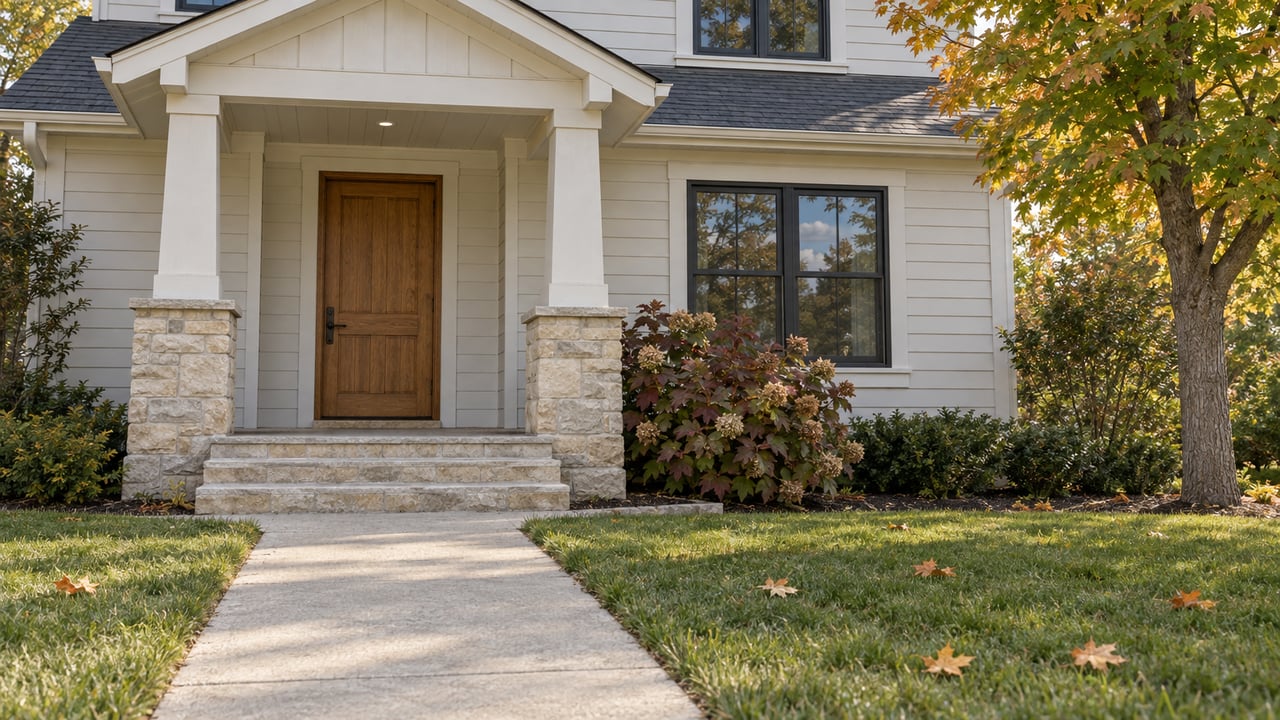
Under Michigan law, the property tax figure printed on an Okemos listing is the seller's bill. The Meridian Township assessing page explains that it is based on a taxable value that has grown by no more than inflation every year since the seller bought. The year after you close, that value resets to the home's state equalized value, which is set at roughly half of market value. The longer the seller owned the home, the bigger the gap between their bill and yours is likely to be. Your purchase price does not set the new number. Meridian Township's assessing office does.
That is the friction this post covers: why it happens, how large it can get on a typical Meridian Township home, and the forms with deadlines that decide whether you pay the lower homestead rate or the higher one.
Three Values On One Parcel
Every Meridian Township property has three numbers. Assessed value is required by law to equal 50% of market value. State equalized value, or SEV, is that assessed value after county and state review, and the township says the two are typically the same. Taxable value is the one your bill is actually calculated on.
Proposal A, which Michigan voters approved in 1994, limits how fast taxable value can rise. Each year taxable value is the lower of current SEV or last year's taxable value, minus any losses, multiplied by the smaller of 5% or the inflation rate, plus any additions such as new construction. The State Tax Commission set that inflation rate multiplier at 1.031, or 3.1%, for 2025 and at 1.027, or 2.7%, for 2026.
SEV has no such limit. Meridian Township's assessing page states it plainly: over time, many properties' SEV has become much greater than their taxable value. The township also notes that those properties saw taxable value rise by the full 2.7% for 2026, even in cases where SEV went down.
So a seller who has owned an Okemos home for many years is paying taxes on a number that may sit well below half of what the house would sell for today.
What Resets When You Close
The Michigan Legislature says that after a qualifying transfer of ownership, taxable value "uncaps" to the parcel's SEV in the calendar year after the transfer. A home you close on this October would uncap for 2027. Some conveyances fall under statutory exceptions and do not trigger uncapping, so a family transfer or similar situation is worth confirming with the assessor.
The new taxable value is not your contract price. The state's Property Transfer Affidavit says outright that purchase price is not presumed to be true cash value. Your taxable value becomes whatever SEV the township has on record for that parcel. The township builds SEV from Ingham County sales studies. The 2026 study used residential sales from April 1, 2023 through March 31, 2025, grouped into economic neighborhoods that can be as small as a single subdivision. The township also reports that residential values generally increased for 2026.
This explains why two similar homes on the same Okemos street can carry very different tax figures on their listings. After a sale, both reset toward the same kind of number.
Putting Numbers On The Gap
Meridian Township published one useful reference point in its August 2026 millage FAQ. The average taxable value of a single-family detached home in the township is $152,864. The same document shows that a home's taxable value cannot exceed 50% of market value, so a $400,000 home tops out at a $200,000 taxable value.
For the Okemos Public Schools area of the township, the 2025 full-year total was 51.6238 mills for a principal residence and 69.6238 mills without the principal residence exemption. The state's rate report notes that these rates do not include the 1% property tax administration fee, so an actual bill runs slightly higher. The township has published 2026 summer rates of 24.2907 mills homestead and 33.2907 non-homestead, but no 2026 winter schedule yet, so 2025 is the most recent complete year. A mill is $1 per $1,000 of taxable value.
The table below is an illustration only. It pairs the township's average taxable value with the 50% ceiling on a hypothetical $400,000 home, using 2025 Okemos-area rates. The figures are millage only and leave out the 1% administration fee. Any real parcel will differ.
| Scenario | Taxable value | Rate | Approximate annual millage tax, before the 1% fee |
|---|---|---|---|
| Seller's bill at the township average | $152,864 | 51.6238 mills, homestead | about $7,890 |
| Buyer's bill after uncapping, SEV at the 50% ceiling | $200,000 | 51.6238 mills, homestead | about $10,325 |
| Same buyer without the principal residence exemption | $200,000 | 69.6238 mills, non-homestead | about $13,925 |
In this example, the reset alone adds about $2,435 a year in millage before the fee. Losing the homestead exemption would add another $3,600 on top of that. The township average is a township-wide figure, and many Okemos homes sell above $400,000, so the gap on a particular house could be smaller or larger. What drives the size of the jump is how far that parcel's taxable value has drifted below its SEV.
Why The Gap Gets Missed At The Offer Stage
The regional market gives buyers little time to dig into this. In August 2026, the Greater Lansing Association of REALTORS® reported a median of 12 days on market across Greater Lansing, sellers receiving 99.4% of list price on average, and 2.5 months of supply. That is still well below the four-to-six-month range the association calls balanced. The regional median sale price was $250,000 that month, unchanged from August 2025. These figures cover all of Greater Lansing, not Okemos specifically.
When homes go under contract in under two weeks, the tax line on the listing tends to end up as the tax line in a buyer's monthly payment estimate. Looking up the parcel's SEV before writing an offer moves that estimate closer to what the bill will actually be.
The Forms That Decide Your Rate
Uncapping happens automatically. The homestead rate does not. Two filings protect you, and the seller files one of their own.
- Property Transfer Affidavit, Form L-4260. The Michigan Treasury says the new owner files it with the township assessor within 45 days of the transfer, even if no deed has been recorded. If you miss it, back taxes can run from the transfer date with interest and penalty, plus a late-filing charge of $5 per day. That charge is capped at $200 for a principal residence and $4,000 for other property. Meridian Township warns that the back taxes can cover multiple years and add up to a substantial amount.
- Principal Residence Exemption Affidavit, Form 2368. The Michigan Treasury says the principal residence exemption removes up to 18 mills of school operating tax, which is the entire gap between the two Okemos rates above. If you own and occupy the home by June 1, it applies to that year's summer levy. If you own and occupy it after June 1 but by November 1, it applies starting with the winter levy.
- Seller's Request to Rescind, Form 2602. If the home was receiving the exemption, the former owner files to rescind it. Their exemption comes off on December 31 of the year of the transfer.
The calendar matters right now. A buyer who closes in October 2026 and moves in by November 1 can claim the exemption for this winter's levy. Moving in on November 2 misses it.
The November Ballot And A Larger Taxable Value
Meridian Township has two millage renewals on the November 3, 2026 ballot: Parks at 0.6503 mills and Police and Fire Protection at 1.4563 mills. The township says both are renewals and would not raise the overall township tax rate. Together they total 2.1066 mills.
The township puts the cost at $322 a year for a home at the $152,864 average taxable value. Its own table shows $421 a year at a $200,000 taxable value. Every mill on an Okemos bill works the same way. A renewal that leaves the rate unchanged still costs a new owner more than it cost the seller, because the rate is applied to a larger number.
Estimating Your Own Number
Start with the parcel's SEV, which is your likely taxable value the year after closing. Multiply it by the homestead rate and divide by 1,000. The Michigan Treasury's Property Tax Estimator compares millage rates across local units, and Meridian Township's assessing page explains each value in more detail. This is general information, not tax or legal advice. The assessor's office or a tax professional can confirm figures for a specific parcel.
Quick Answers
Does my taxable value jump the year I buy? No. It uncaps in the calendar year after the transfer, so a 2026 purchase resets for 2027.
Can my taxes rise even if market values fall? Yes. Meridian Township explains that when SEV is still above capped taxable value, taxable value rises by the inflation multiplier, which was 2.7% for 2026.
What if I think the assessment is wrong? You can appeal to the March Board of Review. The township mails Assessment Change Notices in mid-February, and for residential property, that March appeal is required to keep your right to go further to the Michigan Tax Tribunal.
If you're weighing a home in Okemos, I'm glad to pull the parcel's SEV and current taxable value before you write an offer, so the tax figure in your budget matches what you'll actually pay once the home is yours. Schedule a free consultation with Heidi Smith and we'll go through the numbers together.